
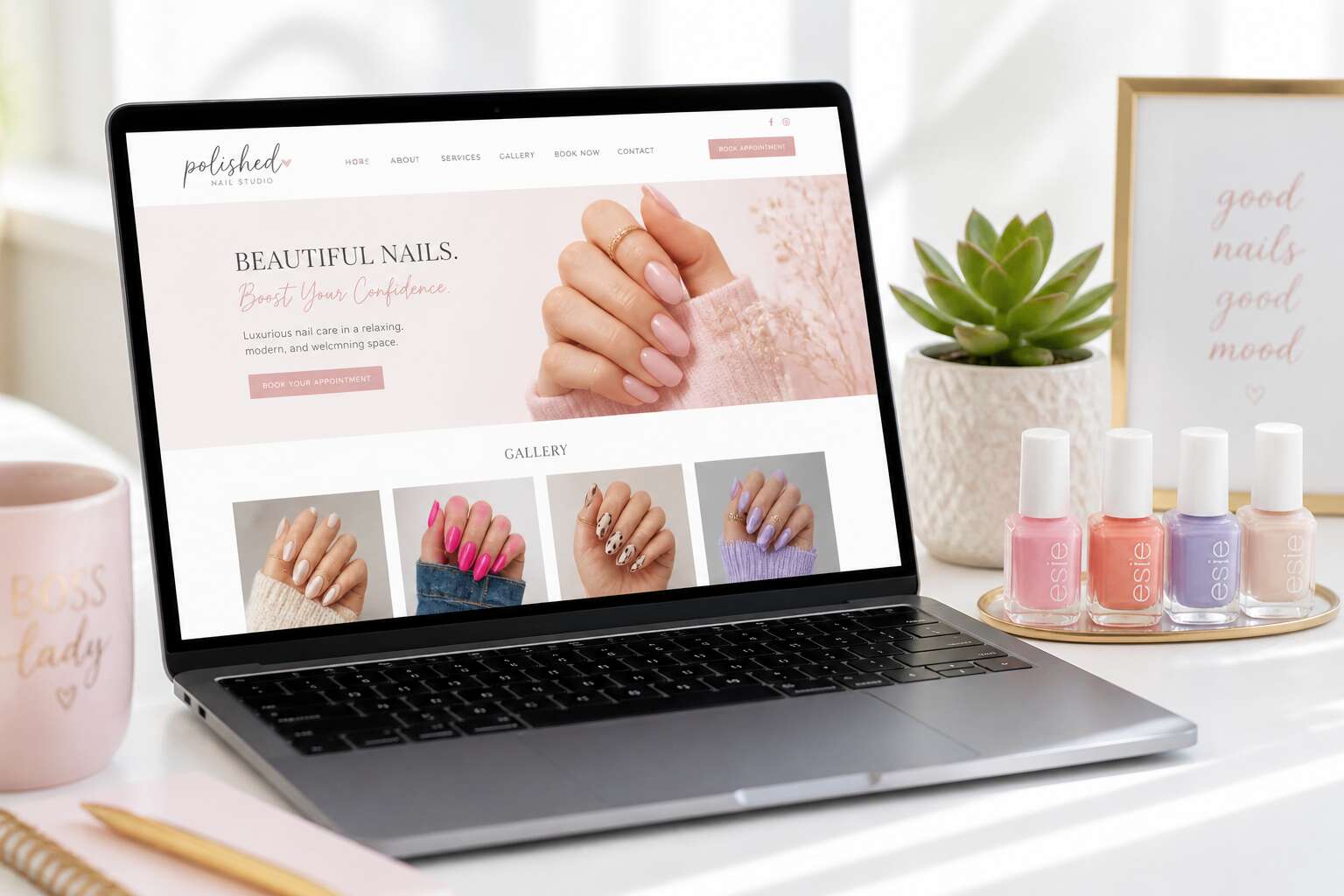
Choosing the Right Foundation for Your Online Presence
Selecting a Memorable Domain Name
In South Africa, 68% of clients research a beauty service online before booking. We have observed this pattern intensify each year! A nail salon website acts as your primary credibility marker, so the foundational choices matter profoundly. The foundation includes your hosting provider, content structure, and visual identity system. These elements determine loading speed, security, and how easily potential clients navigate your services.
Selecting a memorable domain name requires deliberate strategy. It must be short, phonetic, and free of ambiguity. Consider these parameters for a nail salon website:
- Use a .co.za extension to signal local relevance
- Avoid double letters that confuse spelling
- Include a relevant keyword only if it flows naturally
A domain that aligns with your brand name reduces cognitive load for returning visitors. They can recall and type it without hesitation, which directly influences repeat inquiries and word-of-mouth referrals.
Comparing Hosting Providers for Reliability and Speed
When a client clicks through to your nail salon website, the loading time becomes your first impression. A sluggish server signals neglect. In South Africa, where mobile data costs remain a sensitive topic, speed is politeness. Comparing hosting providers requires more than glancing at price tags. Look for uptime guarantees above 99.9%, local server options, and support that answers within minutes, not days.
- Server location relative to your South African audience
- Scalability for seasonal traffic surges
- SSL certification included as standard
Your nail salon website deserves a host that treats reliability as seriously as you treat hygiene standards. The right foundation keeps your booking page accessible during lunchtime rushes and after-hour browsing. Every second of delay costs you a potential loyal client.
Setting Up a Secure and Scalable Platform
Most clients judge your nail salon website within seconds, but the real test happens where clients cannot see. I have seen attractive designs fail because of outdated plugins and unsecured payment gateways. Choosing the right foundation determines whether your online presence survives.
In South Africa, compliance with POPIA is mandatory. Your platform must process client data responsibly, from booking forms to loyalty programs. A secure setup protects you and your clients.
- Select a content management system that supports automatic updates
- Use a reputable payment gateway with fraud detection
- Enable two factor authentication for admin accounts
Scalability matters equally. As appointment slots fill, the platform should expand without friction. A nail salon website built on a flexible architecture adapts to seasonal rushes and new service launches.
Designing a Visual Experience That Attracts Clients
Color Psychology for Beauty and Relaxation
In the first 90 seconds of viewing any website, a visitor forms a judgement based on color alone. For a nail salon website, this impression determines whether a client stays or leaves. I have watched clients decide, and a thoughtful palette creates calm before the first appointment is booked.
Soft rosy tones and warm ivory backgrounds echo the care of a manicure. Deeper shades, like plum or forest green, add quiet luxury. Color psychology suggests these choices slow the heart rate and encourage trust when a client chooses where to spend an afternoon.
- Lavender for serenity
- Peach for gentle energy
- Charcoal for sophistication
These colors must work with photography and white space. A nail salon website that balances bold visuals with generous negative space gives each shade presence. When a client lands on the page, she senses the calm of the salon, a prelude to the experience waiting for her.
High-Impact Imagery and Showcasing Your Work
A single photograph of a finished manicure can say more than a thousand words about your salon. High-impact imagery drives a nail salon website. Clients want to see the precision of your lines, the gloss of your topcoat, and the warmth of your space before they book an afternoon.
Natural light and close angles bring out the texture of each set. A gallery of recent work builds trust in a quiet way. Including shots of the salon environment, beyond nails, grounds the experience. South African clients respond to genuine scenes.
- Before and after transformations
- Textured nail art details
- Relaxing pedicure stations
Every image must load fast and look sharp on a phone. I have watched clients decide against a salon based on slow, fuzzy photos. A nail salon website that feels cluttered or dull loses interest quickly. Letting the portfolio breathe gives each shade and line room to speak. Now that is a visual experience worth booking!
Layout Best Practices for Mobile-First Browsing
Most visitors decide within seven seconds whether your nail salon website deserves a second look. The layout controls that decision. On mobile, thumb reach matters more than mouse clicks. Menus should sit where fingers naturally rest, and booking buttons should stay visible without endless scrolling.
I test every layout on a small screen first. If the gallery forces awkward pinching or the text runs together, the experience fails. South African clients browse during lunch breaks, on taxis, between appointments. Their patience is brief!
A structure that guides the eye works best:
- Clear service menu near the top
- Book button repeated at logical stops
- Whitespace around each section
This keeps the whole experience open and intentional, not crowded. Speed and clarity do the selling for you.
Typography and Brand Personality
Ninety-five percent of web design is typography, and on a nail salon website, that feels heavier. The letterforms convey the same personality as your greeting at the front desk. A geometric sans-serif reads sharp and modern. A rounded serif reads warm and gentle. This is where brand personality takes shape!
I pair one display font for headings with one clean font for service descriptions. The contrast creates rhythm. Letter spacing matters too; tight tracking feels exclusive, loose tracking feels airy.
For South African clients on patchy mobile data, thin fonts become unreadable. Choose weights that hold their shape on small screens.
Typography choices should mirror your salon’s character:
- A playful script for a trendy Joburg studio
- A refined serif for a Cape Town spa
- A neutral sans-serif for a suburban franchise
Each option shifts the emotional temperature of your nail salon website. Clients feel those differences instantly, almost without noticing.
Creating an Accessible and Inclusive Interface
Small movements shape trust. Each hover effect or gentle transition signals that your team cares about the details. Whitespace does the same. It gives services room to breathe.
Accessibility broadens that welcome. A screen reader user deserves the same ease as someone scrolling with their thumb. The essential elements are simple.
- Descriptive alt text for every image
- Visible focus indicators for keyboard navigation
- Sufficient contrast between text and background
For South African visitors on limited data, every lightweight element matters. It is an act of respect.
I always ask whether each potential client can move through this nail salon website without friction. If they can’t, the experience fails, quietly.
Using White Space to Guide Attention
Most visitors decide within seconds whether a nail salon website feels trustworthy. White space, the quiet area around images and text, controls that decision. It directs attention to what matters: your menu, your prices, your booking prompt. Without it, everything competes and nothing wins.
A sparse layout reads as confidence. Your work does not need to shout. Give each service photo room to stand alone, and let the eye rest before moving on. This rhythm mirrors the calm clients expect when they visit your studio.
Consider how white space can shape priority:
1. The booking button should sit alone.
2. Price lists need separation to avoid confusion.
3. Each image benefits from a clear border of emptiness.
For South African visitors on slow connections, this clarity also reduces scroll time. A well composed page respects their data and their patience. White space is not wasted space; it is the pause that sells.
Essential Features to Boost Client Engagement
Integrating an Intuitive Online Booking System
A client who must phone to book often hesitates. That hesitation costs you the appointment. An intuitive online booking system placed within your nail salon website transforms browsing into a reservation. Clients select their therapist, choose their treatment, and see live availability without friction.
Consider what the system must offer:
- Instant confirmation via SMS or WhatsApp
- Automated reminders that reduce no-shows
- A simple rescheduling option that avoids phone tag
These features save time and build trust between you and your clients. When booking feels effortless, clients return sooner and speak of your studio with genuine enthusiasm!
I have seen salons double their booked hours simply by removing the barrier of a phone call. Your nail salon website must work even when you cannot, confirming bookings at any hour. That constant availability reassures clients and keeps your calendar full.
Displaying Your Service Menu with Clear Pricing
Price transparency drives client trust. When your nail salon website lists treatments with accurate costs, you remove the uncertainty a visitor feels when prices stay hidden. A menu that hides prices invites hesitation. One that displays them invites bookings. Clients in South Africa compare several studios before committing. They want to know what a gel manicure costs, what a pedicure includes, and where they can find a deal. Your pricing should reflect the experience you offer. Group services by category to reduce confusion:
- Manicures and nail art
- Pedicures and spa treatments
- Extensions and overlays
Each line should state the treatment, the duration, and the price. Use plain language, not salon shorthand. A well structured menu on your nail salon website signals efficiency before a client ever walks through your door.
Featuring Your Team Profiles and Certifications
Only 12% of South African nail salons display their technicians’ credentials on their websites. That gap costs bookings. A nail salon website that introduces the people behind the polish turns curiosity into confidence.
Your team profiles should read like conversations, not CVs. Name, signature style, favourite technique, years in the trade, and the certifications that back it all up. Clients in South Africa want to know who will hold their hands. A manicurist with SAAHSP accreditation or a CND certificate carries weight.
This part of your nail salon website answers the question ‘who will be filing my cuticles?’ Details worth including in each profile:
- Training institution and certification year
- Specialisations like gel sculpting or nail art
- Languages spoken
- A candid photo at the nail desk
That last one matters. A studio headshot is fine, but a photo of hands mid-service shows real skill. I once booked a studio for this reason alone.
Showcasing Client Testimonials and Reviews
A single review can tip a booking calendar, but many reviews build trust. South African clients read three or four reviews before calling. Your nail salon website must make that proof effortless to find. Place verified testimonials beside the booking button, not the footer!
The most persuasive reviews tell a specific story: a bride’s gel manicure that survived the dance floor, or a client who found relief from brittle nails. Use the client’s own words whenever possible. Avoid editing their voice into a generic tone.
Structural elements to look for when curating testimonials:
- The technician’s first name to personalise the praise
- A specific service name, not a generic ‘pedicure’
- The outcome or how long the look lasted
Refresh these voices every month. A stale review from 2019 signals neglect. Respond publicly to every comment, including the critical ones, with steady professionalism. Your nail salon website becomes an active conversation.
Adding Interactive Elements Like Virtual Nail Try-Ons
Most booking decisions are made between midnight and 7am, when the salon is dark. That is the moment a virtual nail try-on earns its place on your nail salon website. Clients scroll through shades while the kettle boils, testing gel colours against their own skin tone without leaving WhatsApp.
A strong try-on tool should feel like a mirror, not a toy.
- Render realistic gloss and texture, not flat colour blocks
- Match a minimum of 12 skin tone ranges
- Save and share results to social platforms
Once a client sees her hand with that burnt orange gel, she is no longer browsing. She is planning. The nail salon website becomes a decision tool, and a decision made at home is a booking made in the morning.
Driving Local Traffic Through Search Optimization
Optimizing Meta Tags and Headings for Local Search
Most local searches end in a visit within a few hours. Yet many nail salons lose that traffic because their meta tags say nothing useful. Your nail salon website should tell Google exactly what you do and where. A title tag with your suburb, a heading with your signature service, and a meta description with your street name.
Use your headings to answer real questions. Someone searching ‘acrylic sets in Durban’ wants confirmation you offer them. Someone searching ‘walk-in pedicure Cape Town’ wants to know your hours. If your headings say those words, the search engine matches you to the query. A nail salon website that speaks in local terms wins the click.
Structure your on-page fields around local intent:
- suburb and city in the title tag
- service names in the H1
- phone number in the meta description
Leveraging Google My Business and Local Directories
Over seventy percent of mobile users click to call a business directly from a Google search result. That single action starts with your Google Business Profile, not your website. Yet the two must work as one. Your nail salon website needs to mirror the exact address and phone number you submit to Google.
Local directories such as Yelp, Brabys, and Hotfrog operate as validation sources for search engines. When a client searches for a manicure in Durban, Google cross-checks these listings. If your nail salon website says one thing and Brabys says another, you lose the traffic.
Maintain absolute consistency across these platforms:
- Use the same suite number and road name
- Keep your opening hours identical everywhere
- Update your service menu with current prices
Leverage Google My Business by posting photos of your gel sets weekly. Fresh images and updated offers signal reliability to the algorithm. The longer your profile stays active, the stronger your local ranking becomes, funnelling direct visits to your nail salon website.
Creating Location-Specific Content and Landing Pages
When a client searches for a gel manicure in Durban North, she expects a page that speaks to her suburb. Generic homepages do not capture that search. A nail salon website with dedicated landing pages for each area you serve will match the query with precision. Create a page for Umhlanga, another for Gateway, and one for La Lucia. Each page must include your address, a map, and a call to action. Do not duplicate content.
- Mention a landmark near your salon, such as the Pavilion or a distinctive shopping centre.
- Reference the parking situation or mall access to answer practical questions.
- Include testimonials from clients who live in that specific neighbourhood.
Link each landing page to your main booking system. This structure tells Google that you are relevant to that neighbourhood, and it funnels the visitor to your nail salon website with a purpose.
Building Quality Backlinks from Local Influencers
Seventy-six percent of people who search for something nearby visit a business within a day. For a nail salon website, that statistic is the difference between a booked schedule and an empty chair. Local traffic behaves differently from broad search audiences. A nail salon website that ranks for suburb-level queries captures visitors ready to book. When a client in Ballito searches for nail art near her, she expects a salon that understands her context. Ensuring your site’s architecture signals relevance to the area, from internal links to embedded maps, strengthens visibility without duplicating content.
Backlinks from local influencers amplify that relevance. When a Durban beauty blogger links to your nail salon website, search engines treat it as a regional endorsement. The goal is securing links from accounts with genuine community engagement, not irrelevant submissions.
Converting Visitors into Loyal Customers
Crafting Clear Calls-to-Action That Stand Out
Most visitors arrive at a nail salon website eager to book, yet hesitate at the last moment. Vague instructions like click here give them reason to pause. Specific language such as reserve your gel manicure removes that uncertainty. Every button must tell visitors exactly what they receive.
Placement matters as much as wording. A salon website often buries its booking link beneath policies and staff bios. The call-to-action should appear beside the service menu, after the gallery, and in the footer. Repetition works!
Urgency changes behaviour without pressure tactics:
- Front desk appointments vanish by Friday
- Same day slots appear in the booking widget
- Seasonal treatments fade after launch week
A strong nail salon website converts when it tells visitors what happens next. Acrylic refills and express pedicures deserve their own action line. When the choice feels obvious, hesitation fades and clients return.
Offering Promotions and Loyalty Programs
Loyalty is a conversation, not a transaction. A nail salon website that remembers a client’s birthday, preferred polish brand, or pedicure schedule turns a routine appointment into a relationship. South African clients value familiarity. They return to the technician who knows their cuticle quirks and their favourite shade of red.
Promotions should feel like recognition, not spam. A simple points system, where a gel manicure earns credit toward a spa pedicure, keeps clients checking the nail salon website for updates. Seasonal offers, like a winter hand soak or a summer bright polish, create reasons to visit beyond necessity.
- Earn a free brow shape after five visits
- Refer a friend and receive a polish change
- Birthday month discounts on acrylic sets
When the nail salon website communicates these rewards clearly, clients feel seen. The booking page becomes a place of anticipation. Regulars arrive with confidence, knowing their next visit carries value. That sense of belonging keeps the chair full and the schedule steady.
Implementing Live Chat and Quick Contact Options
A staggering 78% of visitors leave a booking page without taking action. That does not reflect your artistry, it reflects your responsiveness. A website with live chat answers client questions right away. A client in Durban might wonder if a shellac manicure fits her schedule, and an instant reply secures the booking. Quick contact options build the same trust on any device.
- One tap to WhatsApp for a price check.
- A callback field for those who prefer speaking.
- A clickable phone number for urgent queries.
When your nail salon website includes these channels, every visit feels supported, and supported visitors become loyal clients.
Streamlining the Visitor Journey from Landing to Booking
Every visit to a nail salon website is a sequence of decisions. The visitor lands, evaluates, and chooses. If any step feels uncertain, that visitor leaves. I have studied user behaviour for years, and the difference between a booking and a bounce often comes down to how quickly someone finds the next logical action. The design should guide the visitor from curiosity to confirmation without wasted effort.
Streamlining that journey is not about removing choices. It is about ordering them clearly. The path from landing to booking has three checkpoints:
- A clear service overview that matches what the visitor searched for.
- A transparent pricing structure that prevents surprises.
- A booking widget that preserves the visitor’s context.
Each checkpoint answers a specific concern. Once those concerns are addressed, the visitor feels competent to proceed. The best nail salon website designs make that progression feel effortless, not engineered.
Keeping Your Digital Storefront Fresh and Functional
Scheduled Updates for Seasonal Promotions and Trends
Nothing undermines a beautiful manicure more effectively than a nail salon website that still advertises summer specials in early winter. It suggests a salon too busy to care about details.
The beauty calendar offers natural moments to refresh your content. Autumn invites deeper shades, while summer calls for brighter finishes. Adjusting your site around these shifts can be done with precision:
- Swap banner images to reflect current weather and local occasions
- Revise promotional blocks to showcase limited-time offers
- Add fresh portfolio pieces from recent seasonal work
Scheduled updates keep your nail salon website useful and credible. Clients return because they trust you to stay current, both at the chair and online.
Monitoring Site Performance and Uptime
A nail salon website is a working tool, not a decoration. It needs to load quickly and stay online when clients are browsing on their phones during lunch breaks or late evenings. A slow page or an error message sends potential clients straight to a competitor. The same attention to detail that goes into a perfect cuticle line should go into the digital storefront.
I check the analytics monthly to see which pages are performing and which ones are causing frustration. The data shows what clients actually look for, rather than what I assume they want. A nail salon website that stays functional is one that respects the client’s time.
- Broken image links that ruin the portfolio
- Slow loading times on mobile data connections
- Outdated plugin warnings that signal neglect
A functional site builds the same trust as a clean work station. When the digital storefront works smoothly, clients can focus on the real decision: which shade of polish to try next.
Gathering Feedback to Improve User Experience
A nail salon website requires ongoing attention. Trends shift, and client preferences change. I treat the site as a living document, not a static brochure. Every month, I review the pages that get the most engagement and ask why certain services draw more clicks. That curiosity leads to better placement of popular treatments and clearer navigation for the rest.
Gathering feedback happens in small moments. A client mentions she could not find the gel polish menu. Another asks if we offer nail art for bridal parties. I listen and adjust. Sometimes the insight comes from a short survey after booking confirmation. The responses reveal friction I would never notice on my own.
I look for specific patterns in the feedback:
- Which services confuse visitors
- Which pages cause clients to leave
- Which offers generate the most questions
Each answer becomes a task. Updating the copy, reshuffling the portfolio, or adding an FAQ entry. The goal is a nail salon website that feels as attentive as the front desk.
Integrating Social Media Feeds for Real-Time Content
Most salon owners refresh their physical window displays every few weeks, yet many let their digital shopfront go quiet for months. A nail salon website that still shows last season’s nail art loses credibility fast. Visitors notice. They also notice when the gallery updates alongside the latest Instagram posts, because that immediacy signals a studio that is alive and attentive.
Social media feeds do double duty. They keep the homepage current without requiring a developer every time a technician posts a new set. They also give potential clients a direct view of your daily work. Instead of waiting for a monthly update, the feed streams fresh images as they happen.
Consider what gets pulled into the salon feed:
- New nail art and trending colors
- Client tags and before and after shots
- Behind the scenes clips of the workspace
- Limited time offers printed on cards
Each item reinforces the same message. The salon is busy, skilled, and current.
Functionality must still lead. I have seen feeds that slow down the page or interrupt the booking flow, and they do more harm than good. The best implementations rely on lazy loading and compressed images to keep the experience light. The goal is a nail salon website that feels responsive and smooth, not one that sacrifices speed for a lively appearance. The most effective setups keep the navigation clean and let the social content fill the spaces where a static photo would otherwise sit.
Freshness is a matter of trust. When a potential client in Johannesburg or Cape Town lands on a nail salon website, they are asking whether this place is worth their Saturday. A living feed answers that question with authenticity.
0 Comments